

Open Book Pricing


Open Book Contracting promotes transparency, collaboration, and trust. Maximize value, manage costs, and achieve the best outcomes with our expert approach.
Open Book Pricing Models
Price with a transparent cost base and an agreed margin that both sides trust.
Our open book pricing service helps suppliers and buyers build clear, fair pricing models based on actual costs plus an agreed margin. We analyse your cost data, design the open book, cost plus or hybrid pricing model, and train your team to maintain it. For Unsung Ltd, we built and validated every financial model, including cost estimates, pricing strategies and margin analysis, for a £3m defence contract. Book a consultation to discuss your pricing.
What is open book pricing?
Open book pricing is not just about numbers. It is about building a shared understanding between a business and its partners. By showing transparent cost structures and profit margins, it creates stronger working relationships and keeps supplier and customer on the same page.
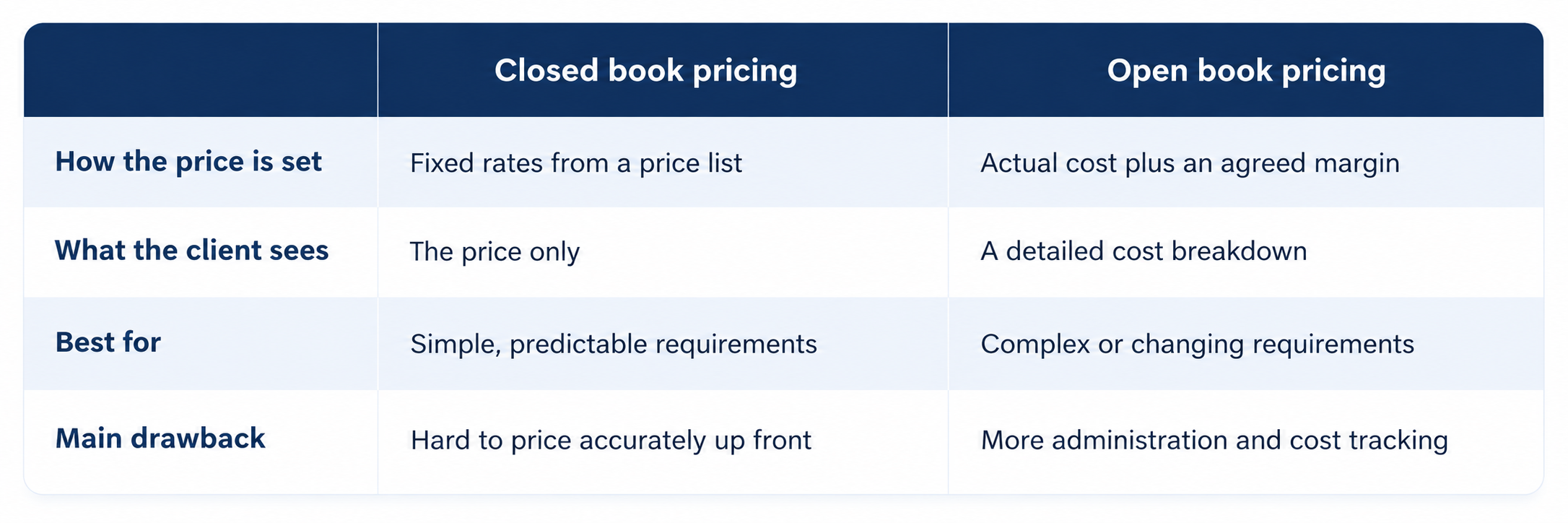
Under open book pricing, the contractor passes on the actual cost incurred plus an agreed margin, and gives the client a detailed breakdown of costs. This builds trust and collaboration, because both parties understand the financials. It also helps the client get a competitive price by monitoring actual costs and profit margins, which prevents inflated rates.
Open book pricing sets the price. The contract terms, governance, audit rights and incentives that sit around it over the life of the contract are covered on our open book contracting page.
Closed book pricing vs open book pricing
Closed book pricing and open book pricing are two different approaches to managing cost, and the difference is especially clear in contracts such as logistics.
Closed book pricing uses a fixed price list. The contractor charges the client set rates for services such as delivery, receiving, storage, picking, packing and dispatch. This model is simple and easy to manage, which suits clients who want simplicity and predictability.
However, closed book pricing can fall short when requirements are complex or unusual. It is hard to set costs precisely up front, which can lead to over- or under-estimating.
Why choose open book pricing?
Business can be hard to navigate, especially when costs feel like a jigsaw. With open book pricing, you are not just making sense of the numbers. You are building trust and clarity in your contract relationships. It keeps all parties aligned on contract costs, which helps reduce cost risk throughout the project.
What's included in our open book pricing service
We guide businesses in adopting transparent pricing, so the financial basis of your contracts is clear, fair and beneficial for everyone. Good accounting systems are essential to maintain transparency and accountability, especially when managing costs and sharing savings, so we build them into the model. You can use the full service or pick the elements you need.
Cost base analysis
We analyse your costs, historical pricing and supply chain data to build an accurate, evidenced cost base. Your data is handled in strict confidence.
Open book pricing model design
We build a financial model that reflects the principles of open book pricing: clear, flexible and easy to use.
Margin and overhead structure
We agree how overhead and profit are recovered, so the margin is fair to the client and sustainable for the supplier.
Cost plus and hybrid pricing options
We advise on whether a pure open book, cost plus or hybrid model fits your contract, and build the one that does.
Open book estimates
We prepare transparent open book estimates for bids and changes, with the cost evidence behind each line. For wider bid pricing, see our bid financial modelling service.
Cost tracking and reporting set-up
We set up the cost collection, systems and reports needed to show actual costs against the model. For profit and loss tracking once the contract is live, see our contract financial management service.
Training and ongoing support
We train your team to update and interpret the model, and stay on hand for changes and questions.
Want a pricing model both sides can trust? Book a consultation and we will scope it with you.
How we work
Our open book pricing engagements follow six steps.
- Initial conversation. Start with a chat. Tell us about your open book pricing goals, challenges and what you want to achieve. Output: agreed objectives.
- Define the scope. Together, we agree the detail: how deep the analysis goes, which areas we focus on and what the model must do. Output: agreed scope.
- Share your data. You share your data, including costs, historical pricing and supply chain details. We handle it in strict confidence. Output: complete cost data set.
- Analyse and recommend. After our first analysis, we share insights, potential issues and recommendations. Output: findings and pricing approach.
- Build and refine the model. We build a financial model that reflects open book principles: clear, flexible and easy to use. We then refine it using your feedback until it meets your needs. Output: final open book pricing model.
- Train, support and grow. Once the model is ready, we make sure your team knows how to update and interpret it. We stay available for adjustments and questions, and refine the model as your business grows. Your feedback helps us improve, and we aim to build a lasting relationship. Output: trained team and ongoing support.
Cost plus contracts
Cost plus contracts, often called open book contracts, are a popular pricing structure in industries where projects are complex and unpredictable, such as construction. The contractor is paid the actual costs incurred plus a markup to cover overhead and profit. This gives a high level of transparency, as clients can see every cost on the project.
The main advantage of cost plus contracts is flexibility. They can adapt to changing requirements or market conditions, which makes them ideal where scope and costs are hard to estimate up front. They also support collaboration, as clients can take part in cost discussions and make decisions using detailed cost information.
However, cost plus contracts can take more administration than fixed price models. Costs must be tracked and documented carefully, which takes time. Even so, the benefits of transparency, trust and flexibility often outweigh the extra effort, especially on large, complex projects.
Hybrid pricing models
Hybrid pricing models combine parts of closed book and open book pricing. They usually set a fixed price for some services and reimburse other costs based on actual spend. This gives the simplicity of a fixed price with the transparency and trust of open book pricing.
Hybrid models suit projects that need a mix of fixed and variable costs. They can adapt to changing requirements or market conditions while still giving detailed cost breakdowns and opportunities to save. However, they can take more administration, because both fixed and variable costs must be tracked carefully.
Despite the extra effort, hybrid models work well for projects that need both predictability and flexibility. They balance simplicity and transparency, so they suit a wide range of projects.
Technology in open book pricing
Technology makes open book pricing much easier to run. It allows costs to be tracked and monitored in real time, giving clients clear access to operational and financial information. Software built for open book pricing can check the accuracy of cost estimates and support cost discussions.
Online portals and platforms play a key role. They support collaboration, communication and document sharing between contractors and clients, which builds trust. They also streamline cost management, reducing administration and improving accuracy.
Automated systems can track and record costs, giving a clear breakdown of spending and helping clients make informed decisions. Technology also makes it easier to combine and analyse data, giving insight into project performance. With this data, contractors and clients can make decisions that improve outcomes and efficiency.
Best practices for managing open book priced contracts
Good contract management is the foundation of successful open book priced contracts, including logistics contracts. Follow these best practices to keep them efficient and transparent:
- Define contract terms and conditions clearly. Make sure every party understands its obligations and responsibilities. Clear terms prevent misunderstandings and set up a strong partnership. A contract obligations matrix helps here.
- Set key performance indicators. Define measures of contractor performance, so contractors meet expectations and deliver value.
- Monitor and track costs. Review and check costs regularly to make sure they are accurate and reasonable. This keeps costs under control and prevents overruns.
- Encourage open communication. Support collaboration and understanding between contractors and clients. Open communication builds trust and helps solve problems.
- Carry out regular audits. Review and audit contracts regularly to make sure they are well managed and comply with the contract terms.
- Write a contract management plan. Set out how the contract will be managed, including how costs are monitored and tracked and how issues are dealt with.
Following these practices helps contractors and clients manage open book priced contracts well, with transparency, trust and mutual understanding. For hands-on help, see our contract management services.
Why work with us on open book pricing
Specialist expertise
Our team knows open book pricing methods well, with over a decade of commercial experience behind it.
Clarity for everyone
We make sure everyone involved understands the financial model and is confident using it.
Built around you
No two businesses are the same, so we build models around your specific challenges and goals.
Proof: results from our pricing and financial modelling work
£3m defence cyber security contract for Unsung Ltd
Unsung Ltd, a specialist PKI and cyber security provider, needed senior commercial leadership to win a £3m Design, Build and Managed Service contract with Babcock International. We built and validated all financial models, including detailed cost estimates, pricing strategies and margin analysis. - Result: £3m contract secured, with a commercially viable and competitive price. - Read the Unsung Ltd £3m case study
£1bn in bids delivered for SDH Project Services
At the start of COVID-19, SDH Project Services had to run 16 separate bids in a 4-month window. We deployed a team of four covering estimating, bid planning and bid execution, and developed the estimating, financial modelling and pricing strategies. - Result: £1bn in bids delivered. - Read the SDH Project Services case study
More pricing results
- £20m incentivisation model designed for Villicare, with profit-sharing and supporting financial models.
- £2m MoD contract for Unsung Ltd, with cost build-ups, pricing structures and sensitivity analysis.
- Standard financial model and automated reporting for Dukebridge.
Our own framework credentials
- G-Cloud 14 – Athena secures a place on G-Cloud 14
- DOS 7 (Digital Outcomes and Specialists), Lots 1 and 3 – Athena awarded a place on DOS 7
Sectors we support
Defence
Defence buyers often require detailed cost build-ups and margin transparency. We have built cost estimates, pricing strategies and margin analysis for defence contracts with the MoD and Babcock International. Our team holds Security Check (SC) clearance.
NHS and health
Health buyers need to show value for public money, so transparent cost-based pricing is often expected. We help suppliers present cost evidence and margins clearly and defensibly.
Construction
Cost plus and open book pricing are common in construction, where scope is uncertain and projects are complex. We build cost models, estimates and margin structures that stand up to client scrutiny. We supported a construction client to a place on the £1.5bn PB4 Public Buildings framework.
Technology
Technology contracts often mix fixed service charges with variable volumes, which suits hybrid pricing. We model both elements so prices stay transparent as usage changes.


Frequently Asked Questions
What data do you need to build an open book pricing model?
Will open book pricing reduce our margin?
What is a hybrid pricing model?
Is open book pricing the same as cost plus?
What is the difference between open book and closed book pricing?
What is open book pricing?
The bottom line
Working with us on open book pricing gives you clear figures and a stronger business relationship built on transparency. Get in touch to talk about your pricing.